
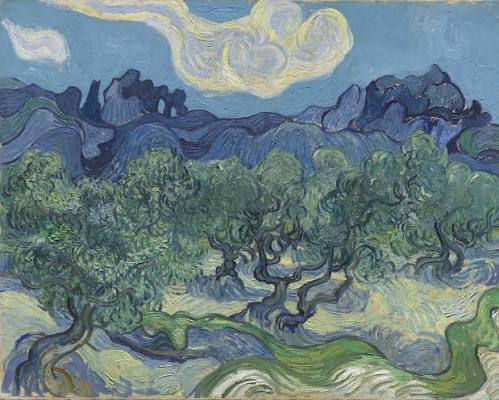
The amount of times Van Gogh painted olive trees says something about their elusive beauty and stature. Perhaps, it is the landscape in which they are usually found that adds to their aura of solemnity. Or their shape, the silvery gray leaves that change colour with the light or their shape.
There is much to be learned from olive trees. They give when they have and when they are depleted by a heavy yield they rest, hold back and withdraw to replenish – not because they are fickle or miserly, but because they know how to stay alive.
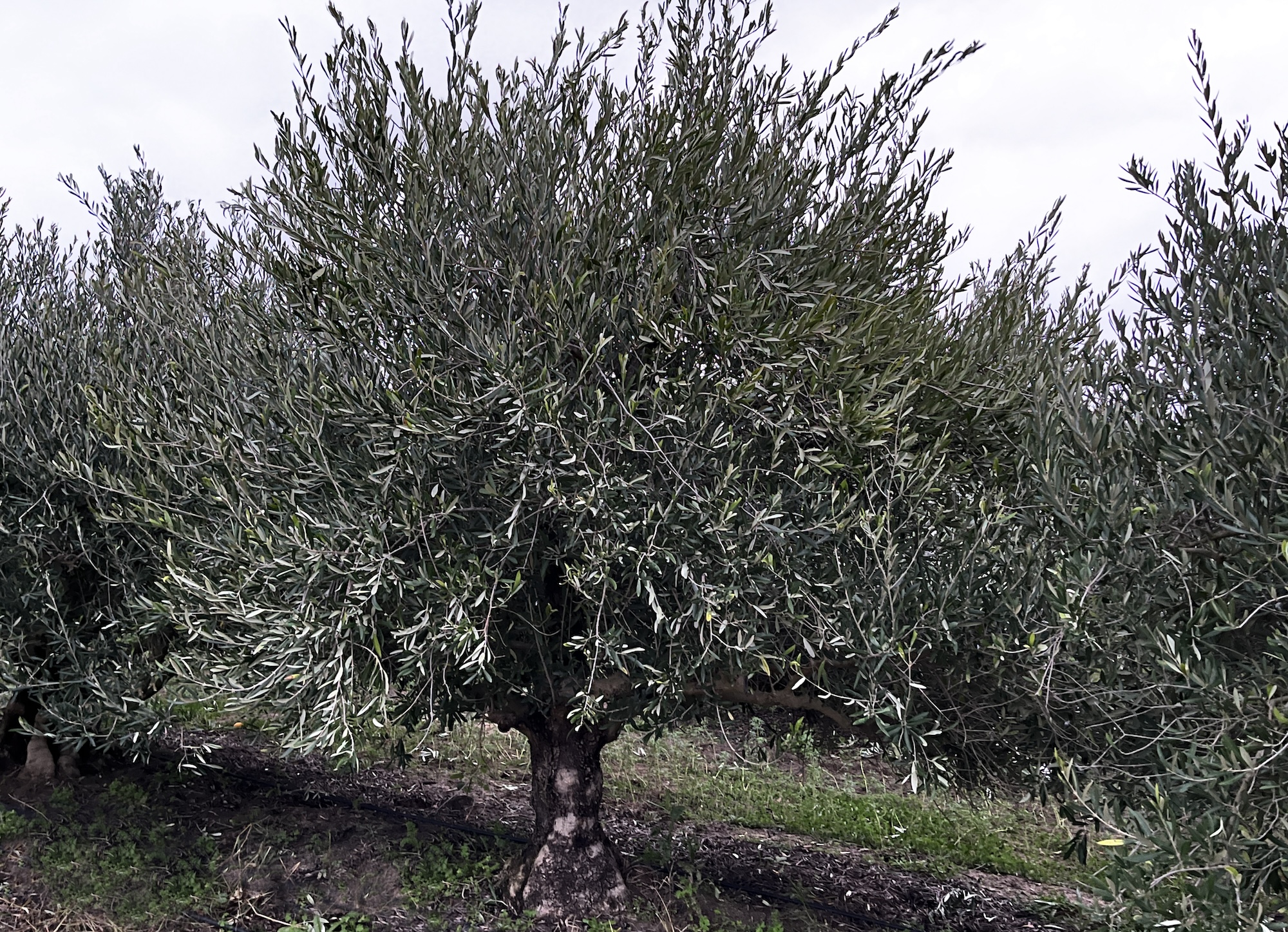
They live in a way that allows them to grow old graciously. With age they lose their lithe, straight stems. Their grow thick and gnarled. This too they bear graciously. Never complaining. Allowing life to happen as it must. In wind and sun and rain, they grow bigger, flower, bear fruit and rest. Year in and year out for a long, long time. The world has changed so much over the past six thousand years of their existence, and still they do what they came to do.
People have picked their fruit and used the oil thousands of years. Monarchs and athletes have been crowned with wreaths of their branches and leaves. Roman soldiers used their branches to signal surrender. They have become part of myths and legends. People study them and cultivate them. Economies have been built on them and wars fought over them. Through the ages they have been a symbol for peace, for hope and reconciliation.
Unaware of the wars and bloodshed, the grappling for power and human chaos, they humbly give what they have. Wisely, asking very little.
“If olive trees knew the hands that planted them, their oil would become tears.”
Mahmoud Darwish
To start at the very beginning, would be with the Greek myth and the founding of Athens, which is linked to the olive tree.
Once upon a time, when old Greek stories were still daily reality, the megalopolis Athens was only a village waiting to spread its wings. In those days people were still humble enough to understand that not everything was in their own hands. And so they turned to the gods to ask them for a specific god. A god, who could guide, protect and feed them with a spirit to give sense to their lives and deeds, in whose name a city could be build. The gods took this request very seriously and after careful consideration Zeus decided, with a feeling of democracy, to let the people choose themselves. So two candidates came down from the Olympus and had to face each other in a competition to win the hearts and souls of the mortals.
It was Poseidon, god of the seas, brother of Zeus, who put his triton into the rock of what later would become the Acropolis and made a spring happily flow its water. Probably because his power was first of all related to the sea, the gift was not sweet, but salted. Athena, goddess of wisdom, justice and war put her spear into the rock. Immediately an olive grow started to grow. This gift was gratefully accepted by the people of Athens and became a spring of a fluid, which Homer called “liquid gold,” considering it one of the treasures of the Mediterranean.
Also According to Greek mythology, it was the minor god Aristaeus who was responsible for the spread of Olive Oil throughout the Balkan Peninsula, the Aegean Sea and later Sardinia and Sicily. It’s no accident, then, that he was considered the inventor of olive oil and the press used to extract it.

Near the murmuring
In the grain fields, of the waves
Of wind in the oat-stalks
The olive tree
With its silver-covered mass
Severe in its lines
In its twisted
Heart in the earth:
The graceful
Olives
Polished
By the hands
Which made
The dove
And the oceanic
Snail:
Green,
Inumerable,
Immaculate
Nipples
Of nature
The olive oil story begins thousands of years ago in the classical era when various Mediterranean civilisations (Phoenicians, Greeks, and Romans) began to grow olive trees and extract juice from the fruit. But it was in Ancient Greece where the olive tree, its fruit and the oil achieved the importance they enjoy today.
The modern olive tree, closely related to the much older Wild Olive, is widely accepted to have originated in ancient Persia and Mesopotamia, spreading towards Syria and Israel in the Mediterranean basin, where it was cultivated and later introduced to North Africa. The domestication of the olive tree is one of the oldest chapters in the history of agriculture.
Olive trees are present in the eastern part of the Mediterranean basin along the coast that extends from Syria to Palestine. Among the oldest trees in the Mediterranean region, in Palestine they are spread over terraces (salassel al-zaytoun), from Acre and Safad to the central region, which includes the villages of the Nablus Mountains, Jerusalem, and Hebron. Archaeological evidence indicates that olive oil production began in the Neolithic period (8300 to 4500 BC), coinciding with the agricultural revolution that took place 10,000 years ago. For example, olive kernels and tools for olive oil production were found in the coastal areas near Carmel Mountain in Haifa, dating back to the seventh millennium BC.
The olive was native to Asia Minor and spread from Iran, Syria and Palestine to the rest of the Mediterranean basin 6,000 years ago. It is among the oldest known cultivated trees in the world – being grown before the written language was invented. It was being grown on Crete by 3,000 BC and may have been the source of the wealth of the Minoan kingdom. The Phoenicians spread the olive to the Mediterranean shores of Africa and Southern Europe. Olives have been found in Egyptian tombs from 2,000 years BC. The olive culture was spread to the early Greeks then Romans. As the Romans extended their domain they brought the olive with them.
With
Intimate
Powerful smoothness
You sing:
You are the Spanish
Language
There are syllables of olive oil
There are words
Useful and rich-smelling
Like your fragrant material
It’s not only wine that sings
Olive oil sings too
It lives in us
with its ripe light
Olive oil first appeared in Ancient Greece on the island of Crete. From there, trade routes were established with Egypt and other Mediterranean peoples. In the Bronze Age, Aegean olive oil was more than a foodstuff. The tablets kept in the palace archives of Crete and mainland Greece record oil as a state commodity – counted, weighed, stored and distributed. It was burned for light, offered in temples, used as a carrier for perfume, and rubbed on the body as a cleanser and healing agent
In Anatolia in the Urla district of İzmir an olive oil workshop dating to the 6th century BC was uncovered, complete with pressing stones, settling basins and a separation system for parting oil from water.
Olive growing in western Anatolia continued through the Roman period; press stones found at rural settlements around the cities show how widespread it was. Production was not interrupted under Byzantine or Ottoman rule either. Ottoman groves were counted among pious foundation revenues, and the oil was traded for cooking, for soap and for lamps alike. Ayvalık, the Gulf of Edremit and Lesbos formed the centre of gravity of that trade.
The Romans adopted the customs, traditions, and techniques of the ancient Greeks, including their knowledge of olive cultivation and olive oil production. In this way, they transformed this product, along with wine and bread, into a fundamental element of their economy and became one of the main exporters of liquid gold in the Mediterranean.
With territorial and military advances of the Roman Empire, where they went their oil went with them and both the transport and cultivation of olive oil improved. The Roman mill was powered by animals, ensuring greater productivity and oil was transported in amphorae. There is, for instance, no doubt that olive cultivation gained greater importance with the arrival of the Roman Empire in Spain, even though it had already been introduced there by the Phoenicians and the Greeks.
Thus, with the Roman occupation of Hispania, the production, trade, and consumption of olive oil was reaching their peak. Olive production expanded significantly in this territory and millions of jars of oil were imported from Hispania to the rest of the Roman Empire.
The Middle English word olyve comes from the Old French olive which stems from the Latin oliva that can be traced back to the archaic Proto-Greek word elaíwa, which became elaía which is the classical Greek word for the olive tree and its fruit.
Linguists believe the Greek term originated from an older Mediterranean pre-Greek or Aegean source such as Minoan or Cretan languages that also influenced words in other ancient languages, like the Old Armenian ewł, meaning oil.
And
among the good things of the earth
I set apart
Olive oil,
Your ever-flowing peace,
your green essence
Your heaped-up treasure
which descends
In streams
From the olive tree.
Excerpt from
Oda Al Aceite – Ode to Olive Oil
Pablo Neruda (1971)
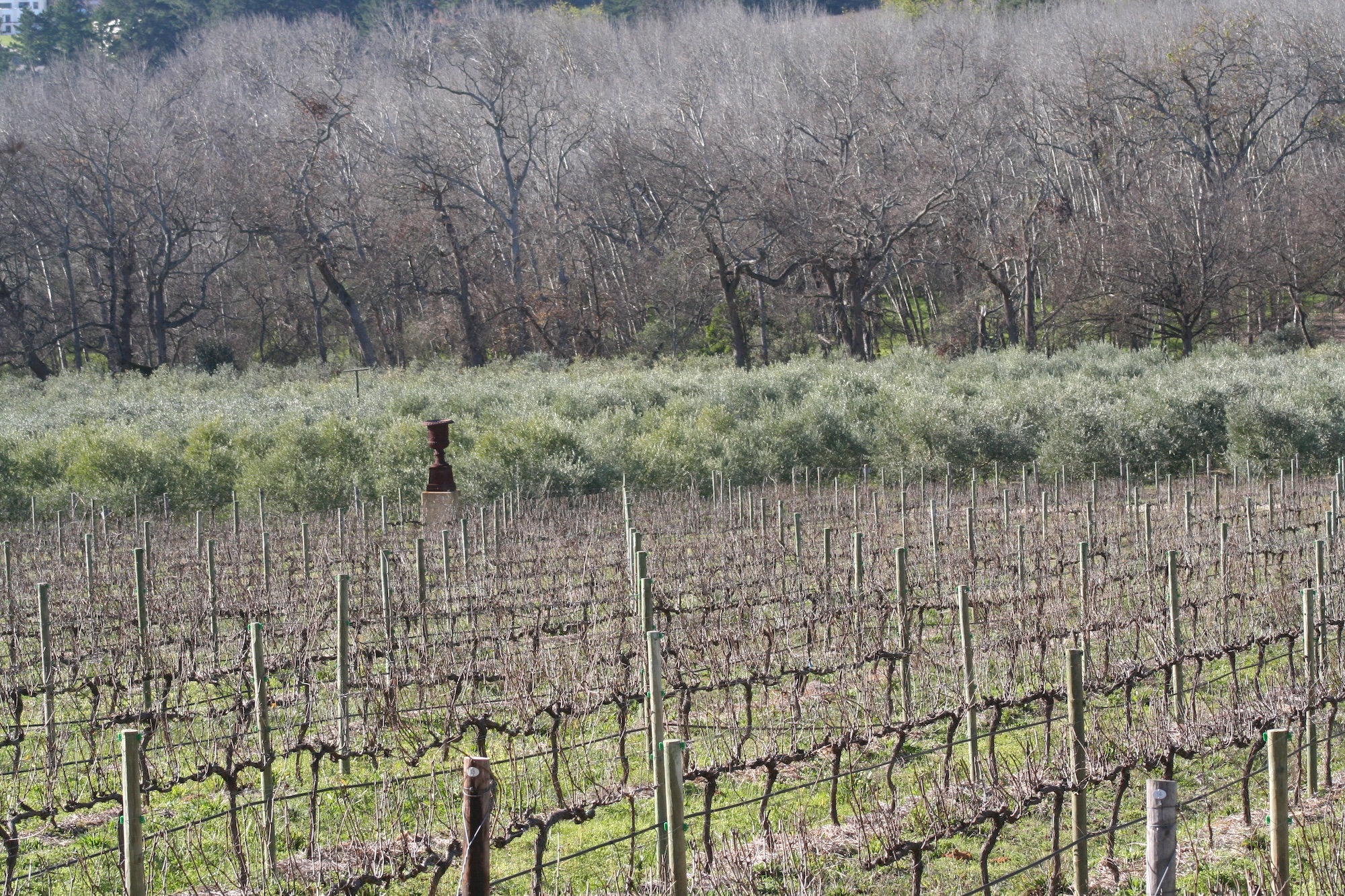
On Kleinood we too make olive oil. It is a small farm with just twelve hectares of arable land. Of these, two hectares are under olive trees. Three Tuscan varieties were selected and planted proportional to the blend we wanted to make. In this way, the flavour of de Boerin Extra Virgin Olive Oil is always consistent, with the only variations from vintage to vintage brought about by natural elements.
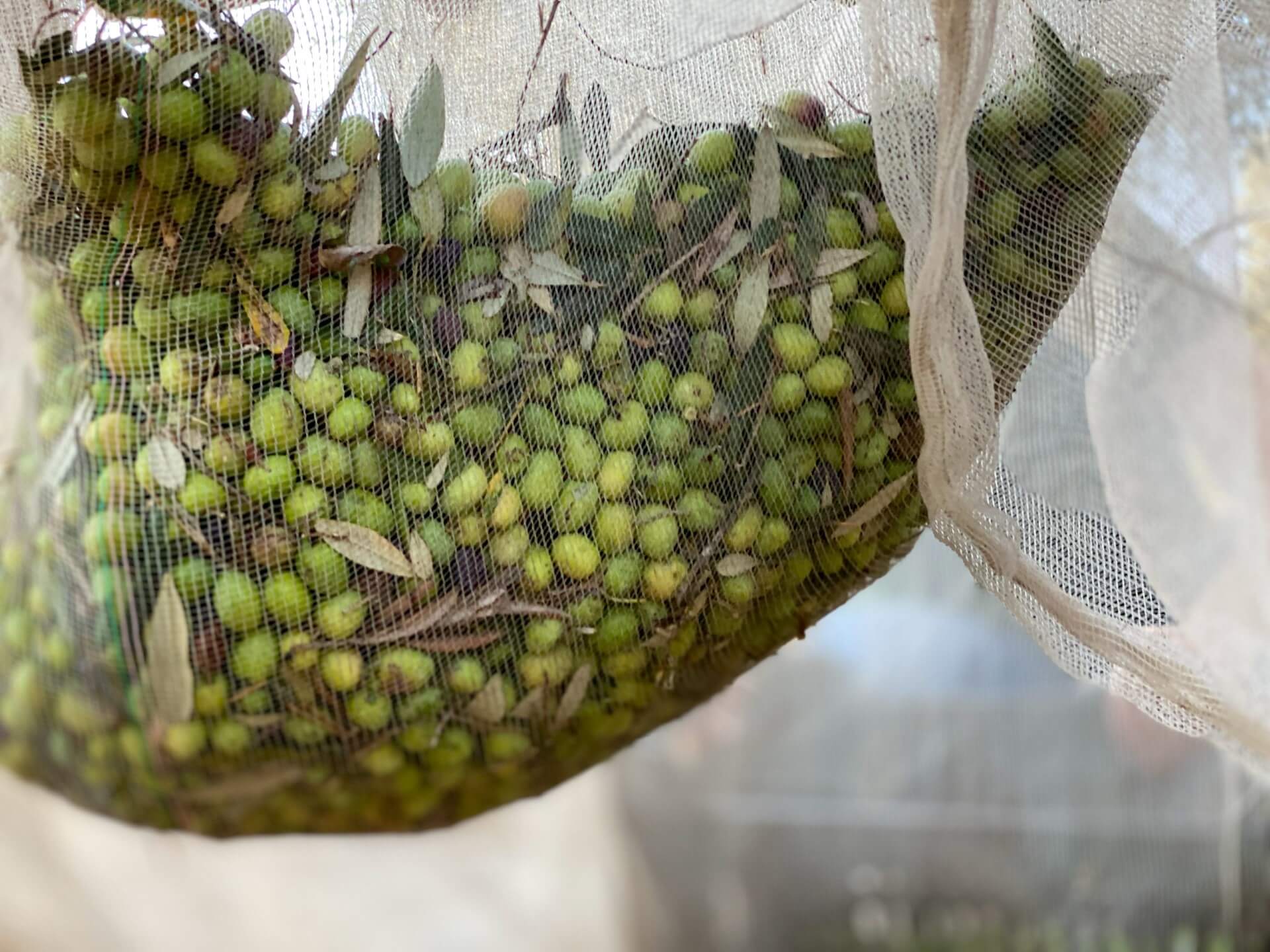
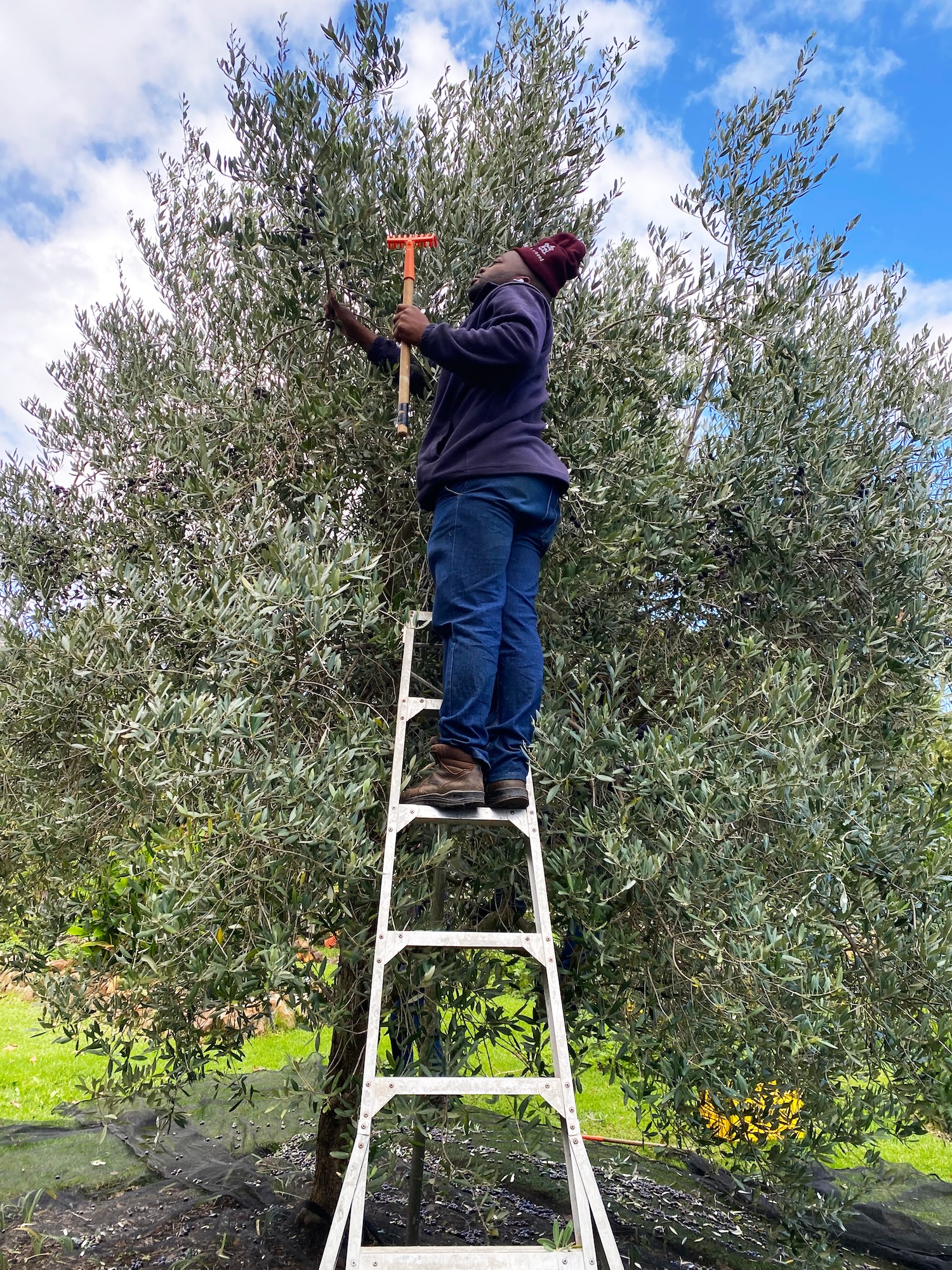
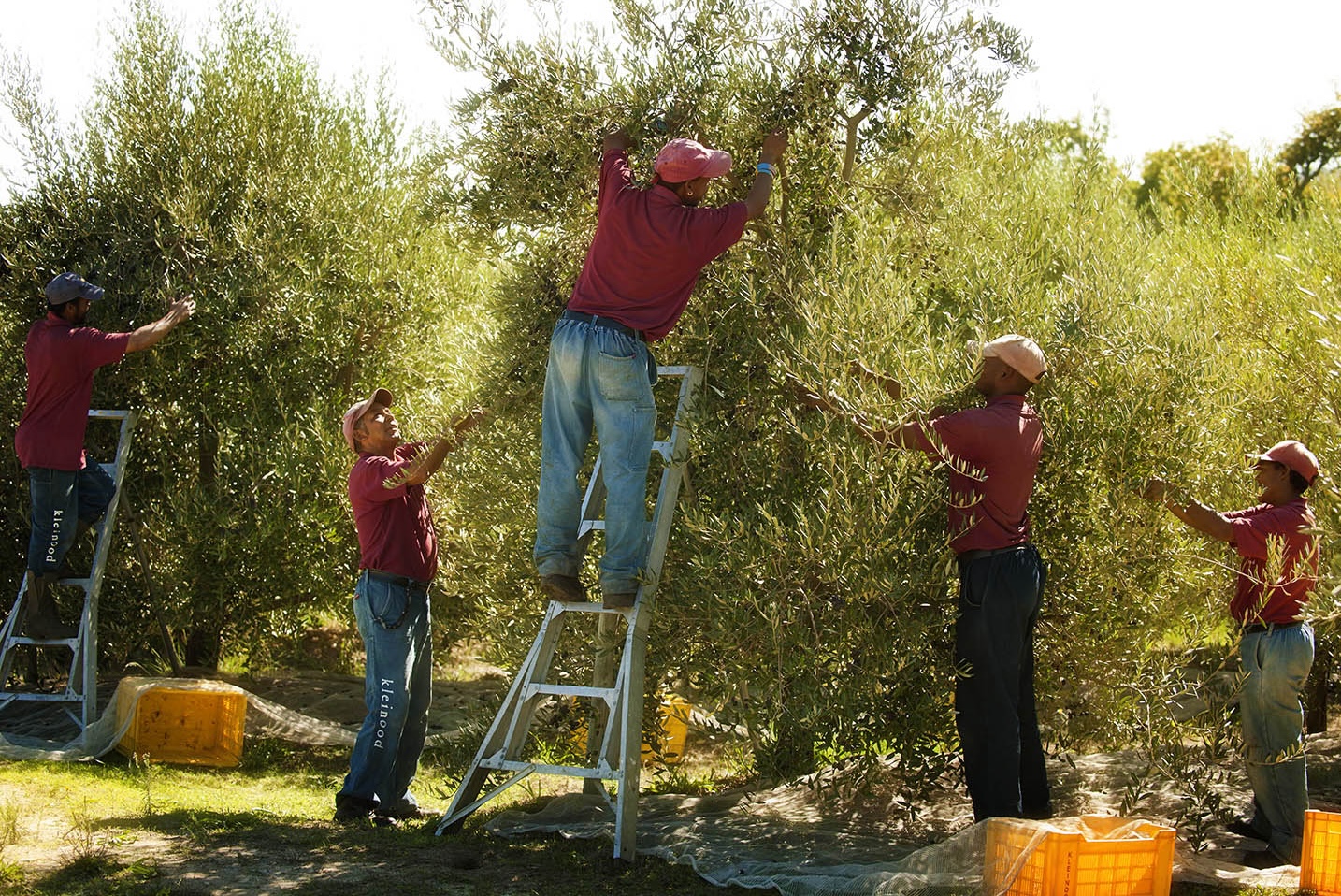
Our trees are becoming gnarly and beginning to look more like the few ancient ones we planted in other areas on the farm. They all bear their beautiful constellations of stars as regularly as they deem fit. When the time is right, the fruit is picked by hand as is the Kleinood way, then cold-pressed and blended, before being bottled, unfiltered, and individually numbered and dated by hand.
Kleinood de Boerin Extra Virgin Olive Oil is an intense and gutsy oil with the strength and generosity that echoes the goodness of the native soil, the sun and the great care that goes into its making.
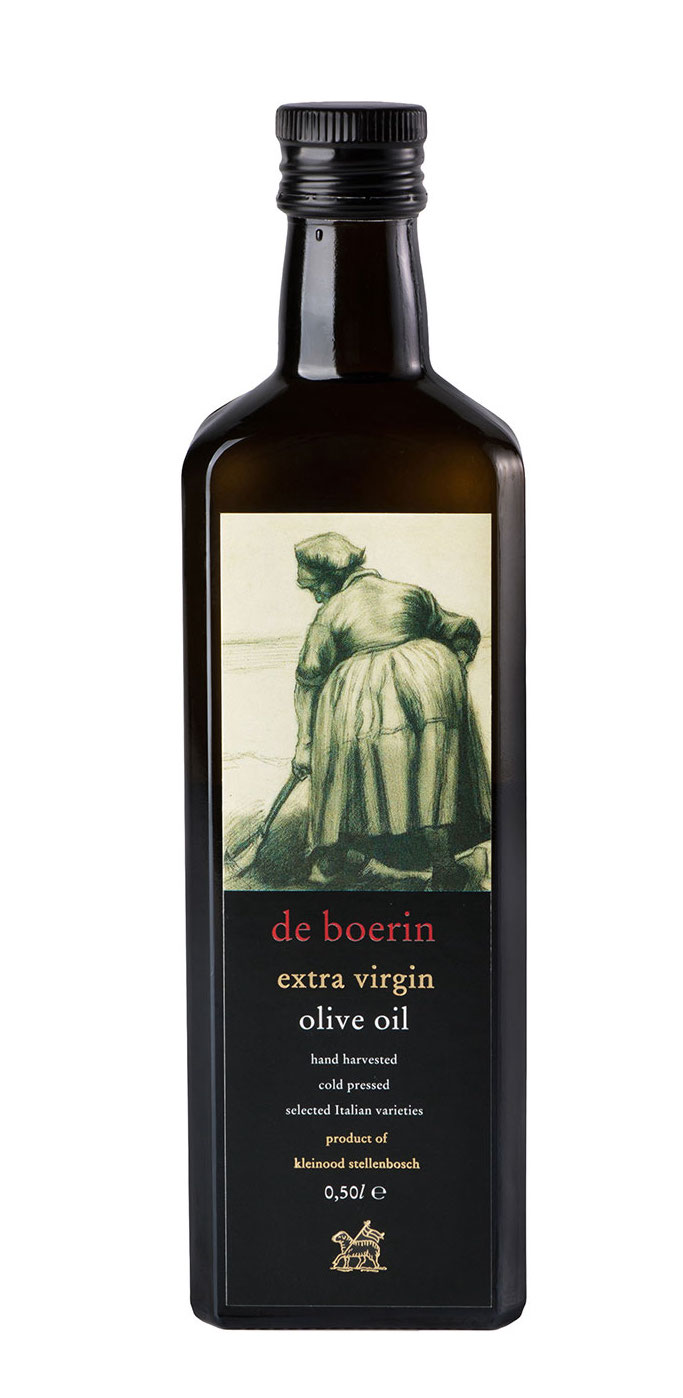
New Release
Kleinood
de Boerin
Extra Virgin Olive Oil
2026

KLEINOOD TERROIR
1046 Trees
North-East Facing
Altitude 210m
Westleigh Soil Type
Mediterranean Climate
ITALIAN VARIETIES
Frantoio: The oil from this prolific variety brings fruit and aroma.
Coratina: A robust cultivar that anchors the blend, lending bold character, structure, and intensity.
Delicata: A gentle aromatic oil imparting subtle charm and balance.
2026 GROWING SEASON & HARVEST REPORT
With olive cultivation, certainty is a rare luxury. While a fierce South-East wind during spring flowering can easily sweep away a promising crop, the Cape winds mercifully held back this season, allowing for a pristine fruit set. To shepherd the trees through dry spells, we adapted our approach with a measured irrigation strategy – delivering deeper, more sustained watering to safeguard tree and fruit vitality.
At harvesting, we gathered approximately 4.5 tonnes entirely by hand, picking each block precisely as individual cultivars reached optimal maturity. Swiftly cold-pressed and left unfiltered, the harvest rewarded us with an exceptional 18.5% extraction yield: a vibrant, expressive oil brimming with character.
2026 TASTING NOTES
The 2026 oil, in particular, shows a captivating, highly aromatic profile balancing green and ripe olives with freshly mown grass and clean olive leaf. The nose unfolds with herbaceous freshness, while the palate reveals generous layers of globe artichoke and green tomato, underpinned by rich, lingering undertones of almond and walnut. A spirited, warming finish of cracked black pepper and wild rocket leaves a lasting impression.
SERVING SUGGESTIONS
The distinctive intensity of this gutsy oil brings life and complexity to any table. Drizzle generously over summer salads, roasted seasonal vegetables, fresh gazpacho, or a simple bowl of boiled new potatoes. Elevate roast chicken, roast lamb and combine with de Boerin Verjus for soft juicy venison roasts. Add lavish amounts when making Minestrone for a rich velvety texture enhancing colour and flavour. Use freely through artisanal pasta dishes, or pour over a bowl of vanilla ice cream.
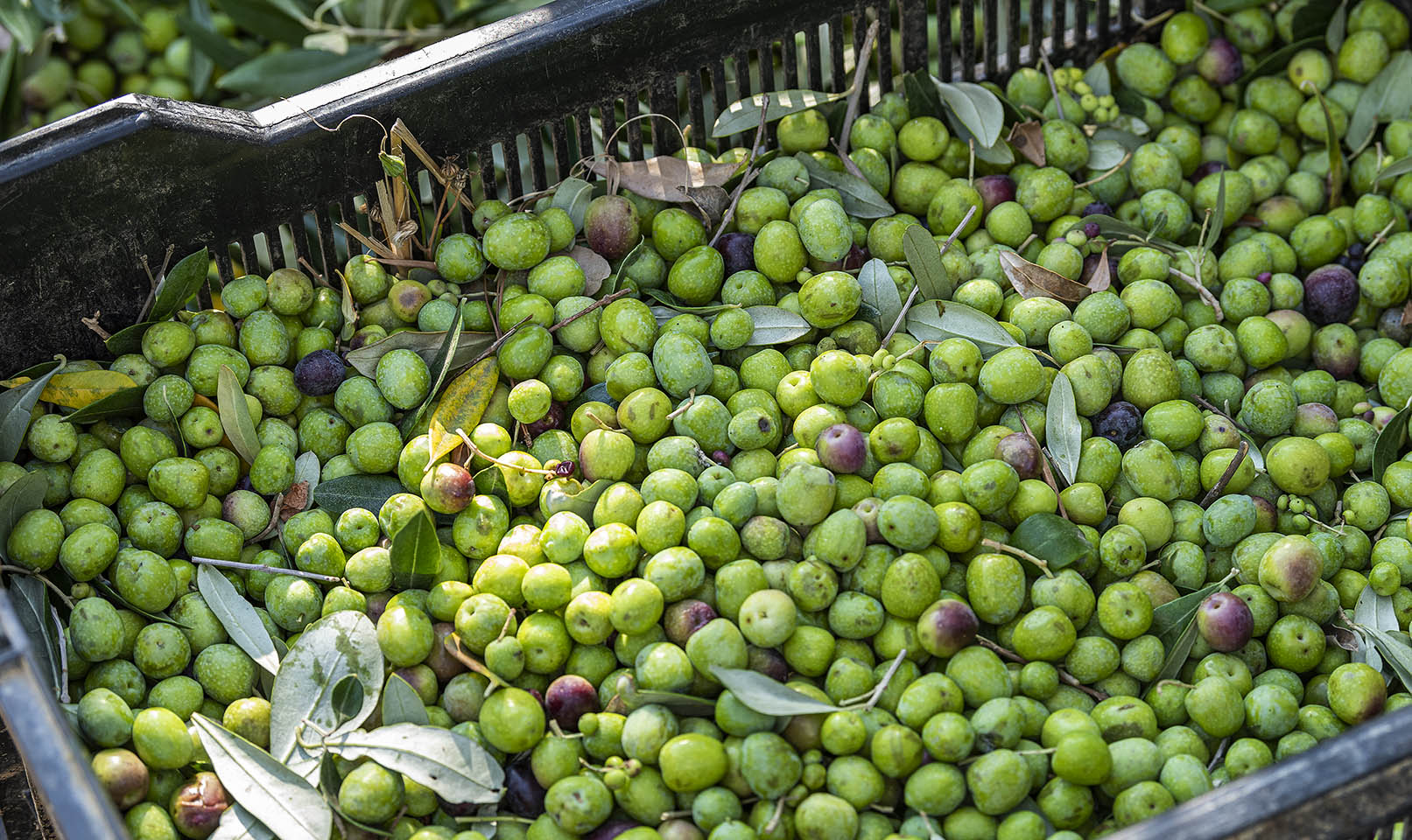
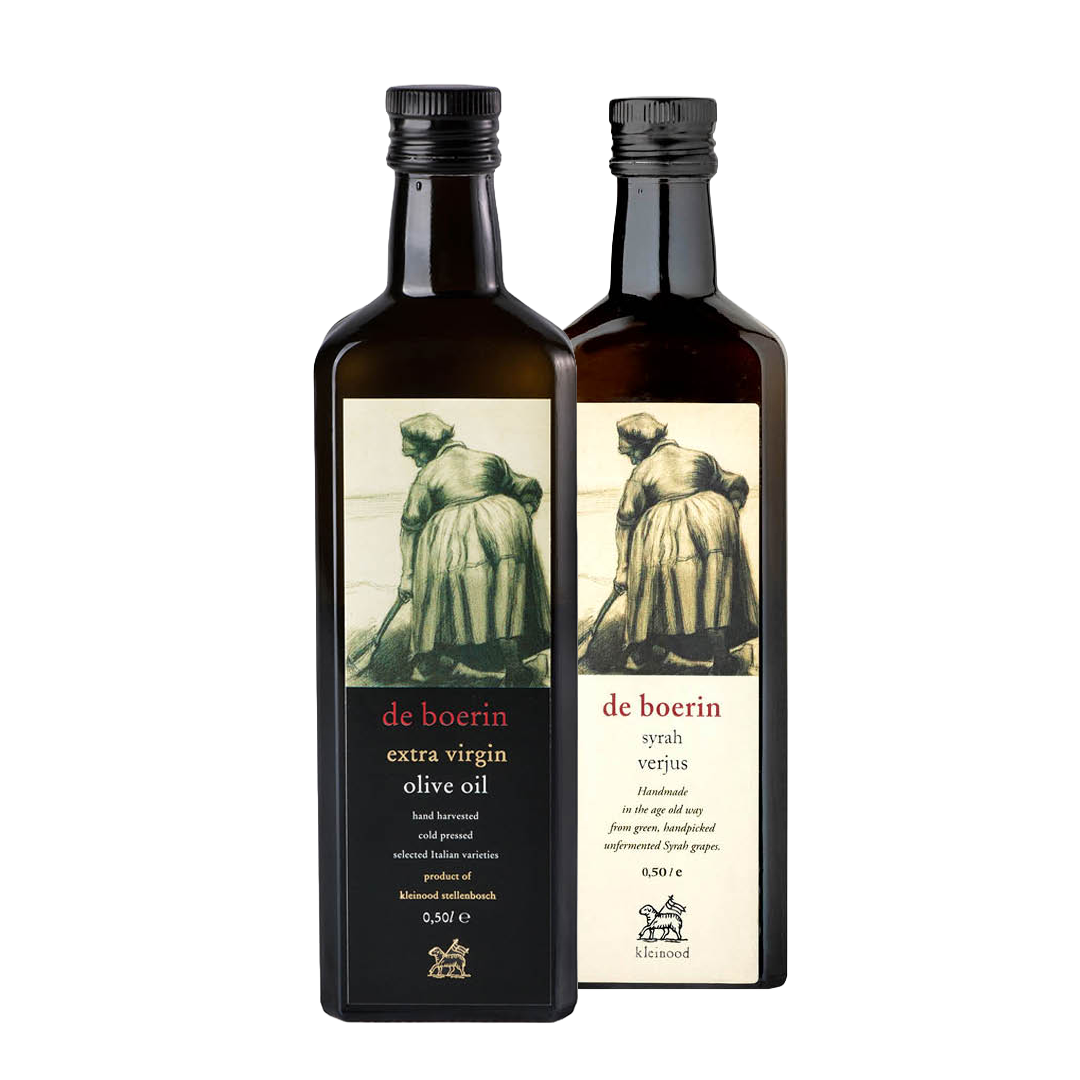

You can find de Boerin’s Extra Virgin Olive Oil, Syrah Verjus, Olive Oil Soap and other pantry items, in the tasting room on Kleinood Farm, via our online store, and at select retailers.

